
No products in the cart.
Learning how to become a qualified electrician in the UK is straightforward once you know the routes. New starters take the Level 3 Installation & Maintenance Electrician apprenticeship, which usually lasts around 48 months and ends with the AM2S. Passing it leads to the ECS Installation Electrician Gold Card.
If you’ve been working on the tools for years, the City & Guilds 2346 is the quickest way to get qualified. It turns your site experience into an NVQ Level 3, and then you take the AM2E. You also need the 18th Edition to stay up to date. Electricians in the UK earn about £38,760 a year, or around £18 an hour, with some places paying more.
Let’s break things down so the whole journey feels simple, steady, and achievable.
How To Become a Qualified Electrician Today?
The path to this career depends on your starting point. You might be leaving school soon. Alternatively, you might have worked on sites for years already. Therefore, there are two main roads to take.
The Path for New Starters
If you are new to the trade, you should choose the apprenticeship route. Specifically, you should apply for the Level 3 Installation & Maintenance Electrician apprenticeship. This is the most common choice. It combines learning at a college with working on a real job. Consequently, you learn the theory and the practical skills together.
You must be patient with this process. You should expect approximately 48 months to completion. It is a four-year journey of learning. During this time, you will have a mentor. They will show you the ropes. Finally, you will take the AM2S as your end-point assessment. This test proves you are ready to work alone.
The Path for Experienced Workers
Some people have worked with electricity for a long time but lack papers. If you are already experienced, perhaps with five or more years of work, there is a different path. You do not need to start from the very beginning. Instead, you can complete the City & Guilds 2346 Experienced Worker assessment.
This qualification is designed for people who know the job well. It helps you gain the NVQ Level 3. After that, you must sit the AM2E exam. This is very similar to the standard AM2, but for experienced people.
Reaching the Gold Standard
Both paths lead to the same goal. You want to be recognised as a professional. After you finish your NVQ Level 3 and pass the 18th Edition (C&G 2382-22), you are close. You must also pass the AM2, AM2S, or AM2E. Once you have all these, you can apply for the ECS Installation Electrician Gold Card. This card is proof that you can work unsupervised. It is like a driving licence for electricians. It tells everyone that you are safe and skilled.
What Does a Qualified Electrician Do?
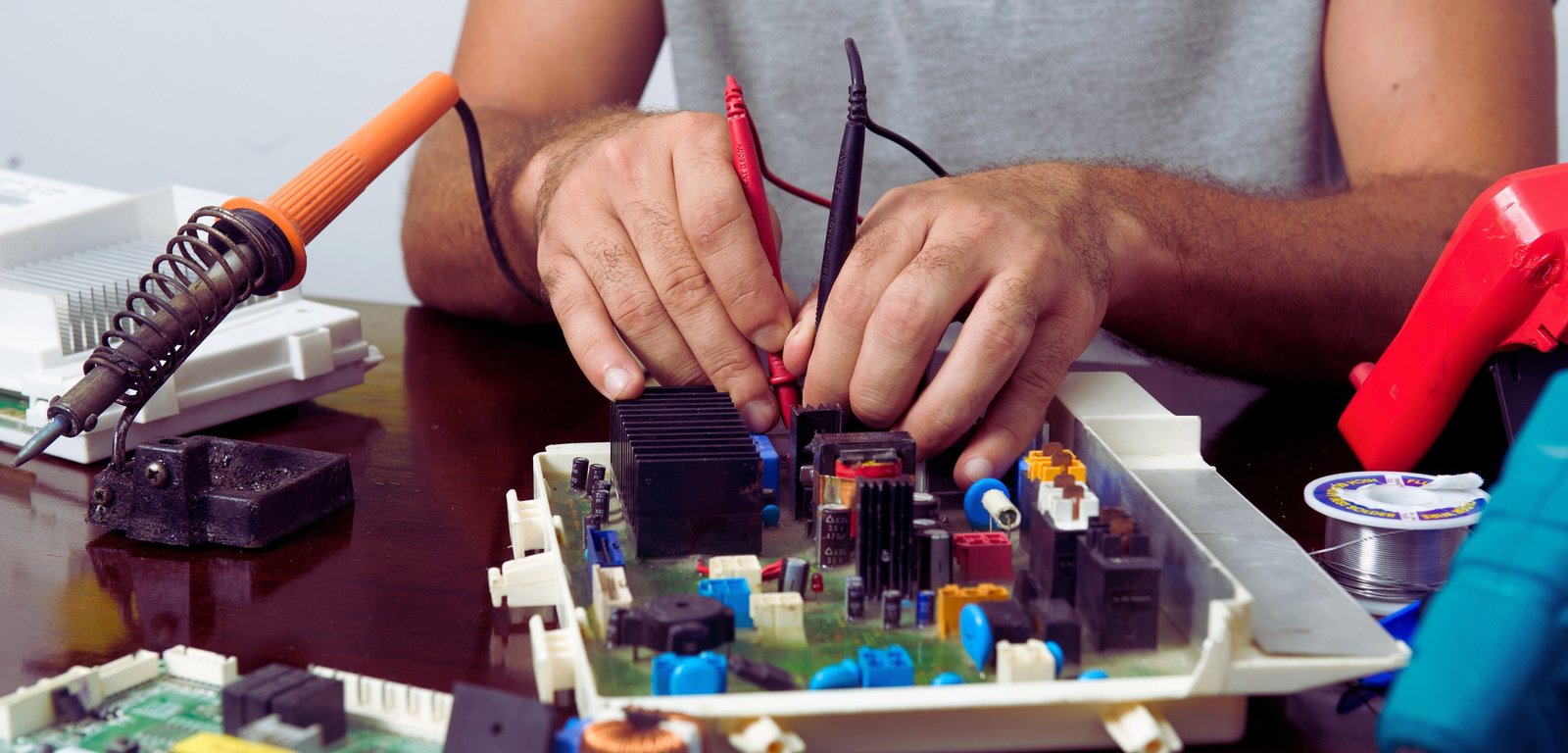
You might think electricians just change light bulbs. However, their job is much more complex than that. They have a huge responsibility. Primarily, they install, commission, maintain, and test low-voltage electrical systems.
These systems are found everywhere. You will find them in domestic settings, like your home. They are also in commercial settings, like shops and offices. Furthermore, they are crucial in industrial settings, like big factories. Every system must be safe. Therefore, electricians certify everything to BS 7671 standards. This is the rulebook for electrical safety in the UK.
Daily Tasks and Challenges
No two days are the same. The tasks span many different activities.
- First-fix: This involves installing cables before walls are plastered.
- Final fix: This involves connecting sockets and switches.
- Fault finding: This is like being a detective to find broken wires.
- EICRs: These are safety inspections of existing electrical systems.
- EV charging: Installing power points for electric cars.
- Integrating controls: Setting up smart systems for heating or lighting.
Electricians who hold a Gold Card have a special status. They can sign off on their own work. This means they promise the work is safe. They do not need someone else to check it for them. To learn more about the full process and timing, check out Open Learning Academy’s “How long does it take to become an electrician in the UK?” It’s a clear guide to planning your career step by step.
What Skills Do You Need to Get Started?
To be good at this job, you need more than just tools. You need a specific set of skills. These skills keep you and your customers safe.
Core Technical Skills
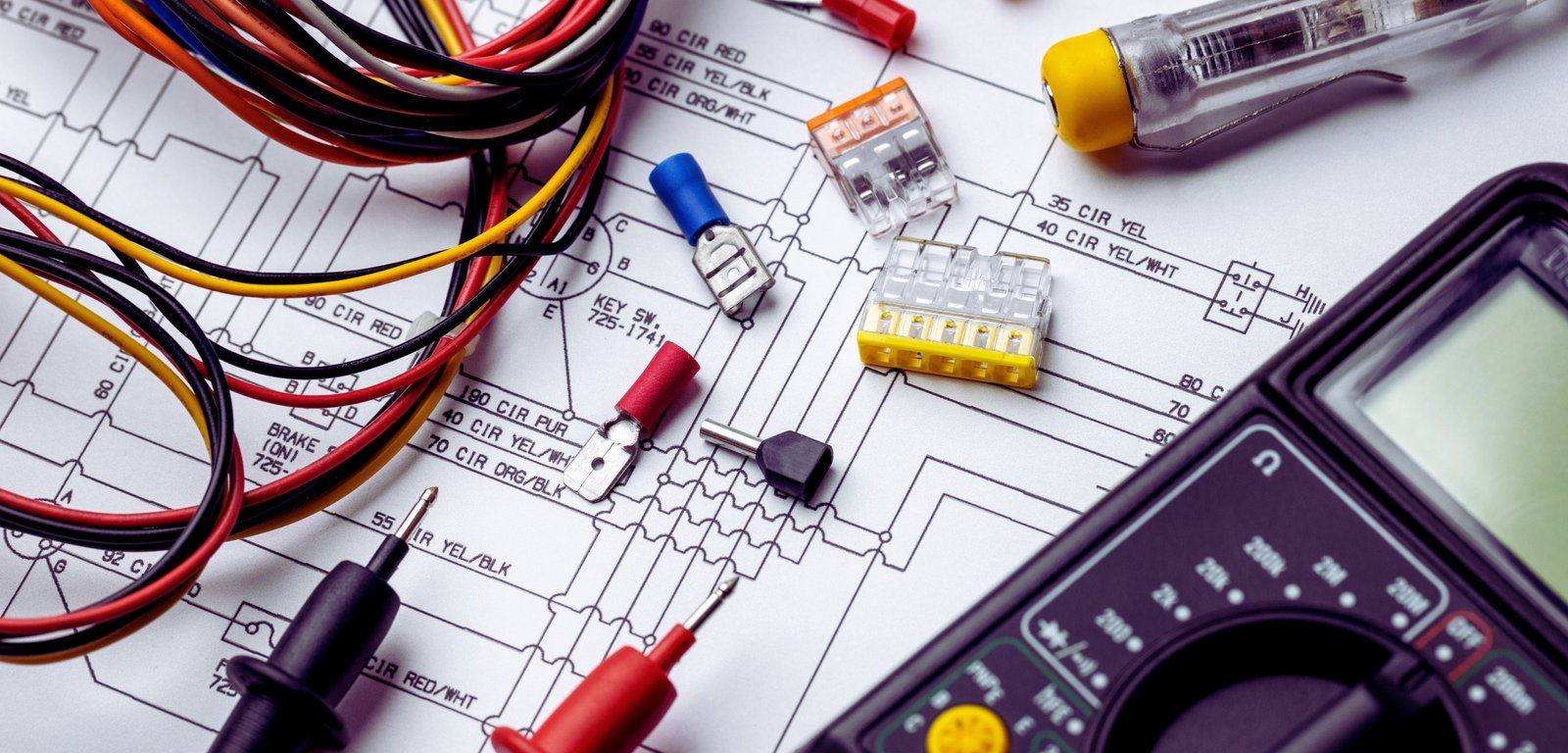
First, you need technical abilities. The most important thing is safe isolation. This means turning off the power safely before working. You must also understand wiring methods. There are many ways to run cables through a building. Additionally, you need skills in inspection and testing. You must check your work to prove it works. Finally, reading drawings is essential. You must look at a plan and know where the wires go.
The Right Mindset
Your attitude is just as important as your hands. You need a mindset of accuracy. A loose wire can cause a fire. Therefore, you must be precise. Problem-solving is also key. Sometimes wires are hidden, and you must figure out the puzzle. Furthermore, customer communication is vital. You need to explain things simply to homeowners. Finally, documenting test results is a big part of the job. You must write down what you found.
Staying Up to Date
Electricity rules change over time. Therefore, you must keep your BS 7671 knowledge current. You do this via 18th Edition updates. This ensures you always follow the latest safety laws.
What Qualifications Do You Need to Become an Electrician?
It can be confusing to understand all the different exams. However, there is a clear list of what you need. You cannot skip these steps if you want to be fully qualified.
The Minimum Set
To be considered “fully qualified”, you need a specific combo. First, you need the NVQ Level 3 (Electrotechnical). This is your main diploma. Second, you need the 18th Edition (C&G 2382-22). This proves you know the safety rules. Third, you need to pass the AM2, AM2S, or AM2E assessment. Taking these three steps leads to ECS Gold Card eligibility. This is the standard target for every new electrician.
Optional Progression
Once you have the Gold Card, you can keep learning. You might choose optional progression routes. For example, you can take the Inspection & Testing (C&G 2391-52) qualification. This is for advanced roles. It allows you to become a Qualified Supervisor (QS) or an Approved Electrician. Provider details vary for this course. Therefore, you should check the awarding body specs to find the right class.
Should You Choose an Apprenticeship or a Training Course?

This is a very common question. Should you go to college or find a job? The answer depends on your situation. However, one route is generally better for beginners.
The Apprenticeship Route
An apprenticeship is usually the best choice for new entrants. The biggest benefit is your employed status. You have a job from day one. Furthermore, you get paid for learning. You earn money while you study. A typical apprenticeship lasts 48 months. It ends with the AM2S EPA (End Point Assessment). This route gives you the most practice.
College and Private Courses
Alternatively, you can take a college or private course. These often award diplomas. This route gives you a lot of theory. You will learn how electricity works in a classroom. However, there is a catch. You will still need on-site NVQ evidence to reach the Gold Card. You also still need to pass the AM2. Therefore, a classroom course alone does not make you a qualified electrician. You eventually need to get a job to finish your training.
How Long Does It Take to Qualify as an Electrician?
Becoming an expert is not a quick process. It takes dedication and time. You cannot rush safety training.
Apprenticeship Duration
If you choose the apprenticeship, it is a long commitment. It usually takes approximately 48 months. That is four years of your life. It is unlikely to be under 42 months without prior experience or credits. This time is needed to see many different types of jobs. You need to work in summer and winter. You need to see easy jobs and hard jobs.
Experienced Worker Duration
The Experienced Worker (2346) route is different. The time it takes depends on you. Specifically, it depends on your portfolio and assessor observations. You have to prove what you can do. Therefore, it is often faster if your evidence is strong. If you have photos and documents ready, you can finish quickly.
How Do You Get Practical Experience?
Reading books is helpful, but you need to use your hands. Practical experience is the most important part of learning. You cannot learn to swim without getting wet. Similarly, you cannot learn electrical work without touching wires.
Logging Your Work
To get experience, you must get employed by a registered contractor. Once you are working, you must log evidence. This includes taking photos of your work. You should also keep test sheets and risk assessments (RAMS). You must map this evidence to your NVQ units from day one. If you wait until the end, you will forget what you did. Furthermore, you should book timely assessor visits. An assessor will come to watch you work. This is standard portfolio practice. Your training provider will outline the exact requirements for you.
Practising Safety
Experience also means practising safety habits. You should practise safe isolation on every job. You must use a lock-off kit and a proving unit. This ensures the electricity is definitely off. It becomes a habit, like putting on a seatbelt.
What Tools and Equipment Will You Need?
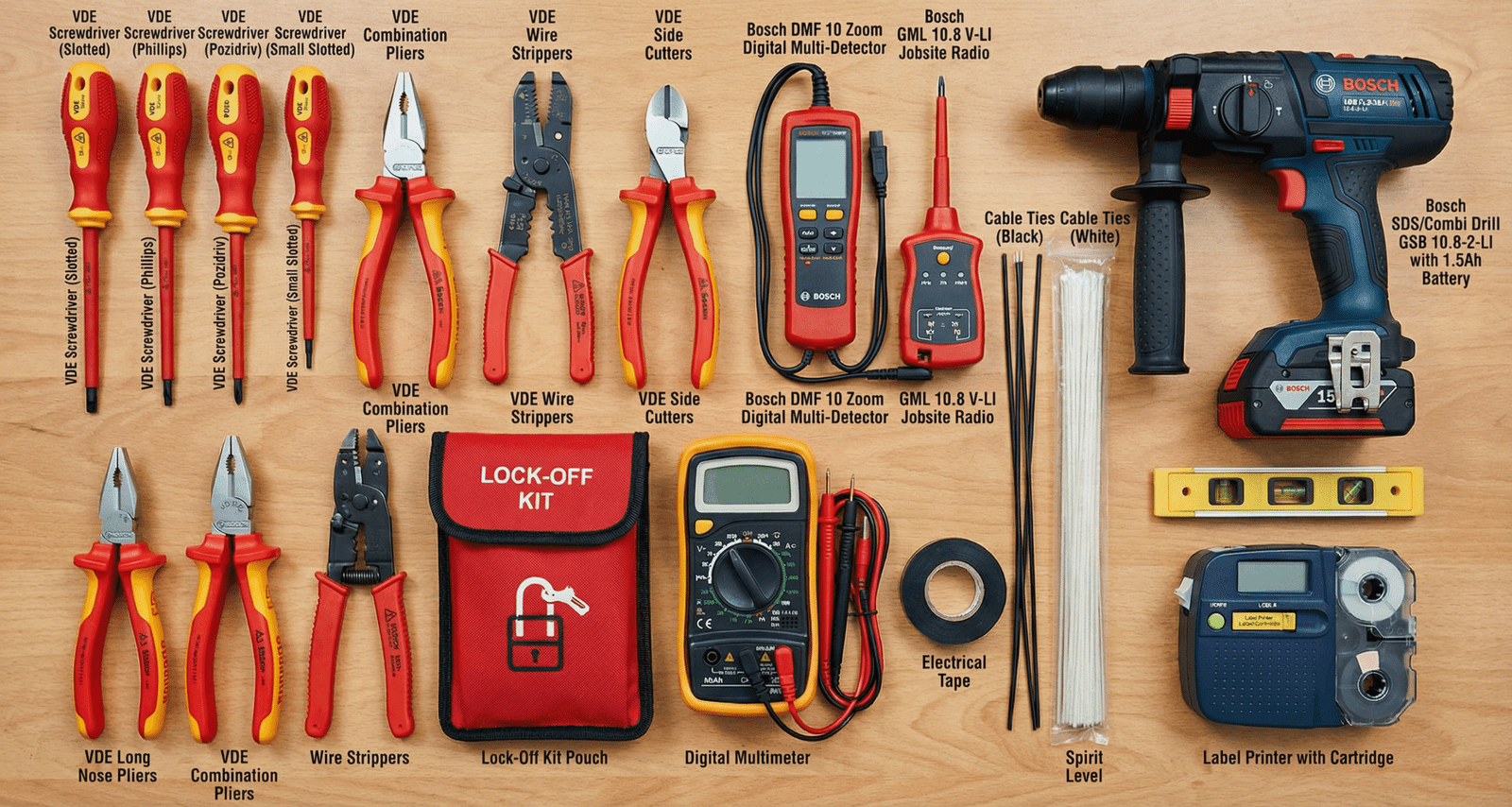
An electrician is only as good as their tools. You need a specific kit to do the job well. These tools are designed to keep you safe from shocks.
Essential Hand Tools
You will need a variety of hand tools.
- VDE-rated screwdrivers: These have insulation to protect you.
- Insulated pliers/cutters/strippers: These handle the wires safely.
- Voltage tester + proving unit: To check if power is present.
- Lock-off kit: To stop anyone from turning the power on.
- Multimeter: For general checking of batteries and fuses.
- Tape/fish rods: To pull wires through walls.
- SDS/Combi drill: To make holes in brick and wood.
- Level: To make sure the sockets are straight.
- Labelling kit: To mark what each wire does.
Testing Equipment
In addition to hand tools, you need testing gear. The most important is a calibrated multifunction tester (MFT). This is an expensive but vital machine. It performs continuity tests to check for breaks in wires. Besides, it does insulation resistance tests and checks loop impedance and RCD tests. All these tests must be done to BS 7671 standards. Furthermore, you must keep calibration records per employer policy. This proves your tester is accurate.
How Much Does Training Cost?
Training to be a professional costs money. There are fees for exams and courses. However, for apprentices, the employer often pays these costs.
The Cost of the AM2 Exams
The final exams have specific fees. We can look at the AM2 family 2025/26 guide prices. The standard AM2 costs £860. The AM2S and AM2E cost slightly more at £935. However, be careful with the AM2E. Some AM2E v1.1 sites may charge up to £1,200. It is important to check the price before you book.
The Cost of the 18th Edition
You also need to pay for the regulation course. The 18th Edition (C&G 2382-22) fees can change. Course and exam fees vary by provider. Therefore, you should check the City & Guilds spec. You should also check local providers for current pricing. Shopping around might save you some money.
How Much Do Qualified Electricians Earn?
One of the biggest questions is about money. Is this career worth the effort? The answer is usually yes. Electricians are well-paid, skilled workers.
Median Salaries
We can look at the latest statistics. Latest analyses using ONS ASHE 2024 show a median of approximately £38,760 per year. This is for full-time electricians. It works out to be roughly £18.04 per hour. However, this is just the middle number. Some earn less when starting. Others earn much more.
Regional Variations
Where you live changes how much you earn. There is regional variation in pay. For example, pay in London is often higher than in other areas. This is because living costs are higher there.
Government Benchmarks
The government also tracks these numbers. Government “going-rate” tables for Skilled Worker visas use ASHE medians. They use these figures as the benchmark for each occupation. This is useful as a cross-check to see if the salary data is accurate. It confirms that £38,760 is a realistic figure.
Final Thoughts on Becoming a Qualified Electrician Today
A good place to start when planning your future is choosing a trade that people will always rely on, and electricians fit that perfectly. For newcomers, the Level 3 apprenticeship steadily builds skill and confidence while you earn. Meanwhile, experienced workers can use the C&G 2346 and AM2E to prove full competence. In the end, careful investment in fees and evidence creates strong, lasting career momentum.
FAQ
How long does it take to become a qualified electrician?
Usually, about 48 months through the Level 3 apprenticeship.
How do you become a qualified electrician in the UK?
Complete NVQ Level 3, 18th Edition, and AM2/AM2S/AM2E, then apply for the ECS Gold Card.
What qualifications do I need to be an approved electrician?
NVQ Level 3, 18th Edition, AM2, plus 2391-52 Inspection & Testing.
Can you become a fully qualified electrician without an apprenticeship?
Yes. The C&G 2346 Experienced Worker route works if you already have solid on-site experience.
Can electricians make 70k a year?
Yes, often through overtime, industrial work, self-employment, or specialist roles.
What’s the quickest you can become an electrician?
Rarely under 42 months. Anything shorter isn’t industry-recognised.
How much do UK electricians earn?
The median is about £38,760 a year (~£18/hour), with higher rates in some areas.
What is the fastest way to become a fully qualified electrician?
If new: Level 3 apprenticeship → AM2S.
If experienced: 2346 Experienced Worker route → AM2E.

Professional Electrician Course
Course Description :
- Certificate: Yes(Free)
- Accreditation: CPD Accredited
- Access: Lifetime


